
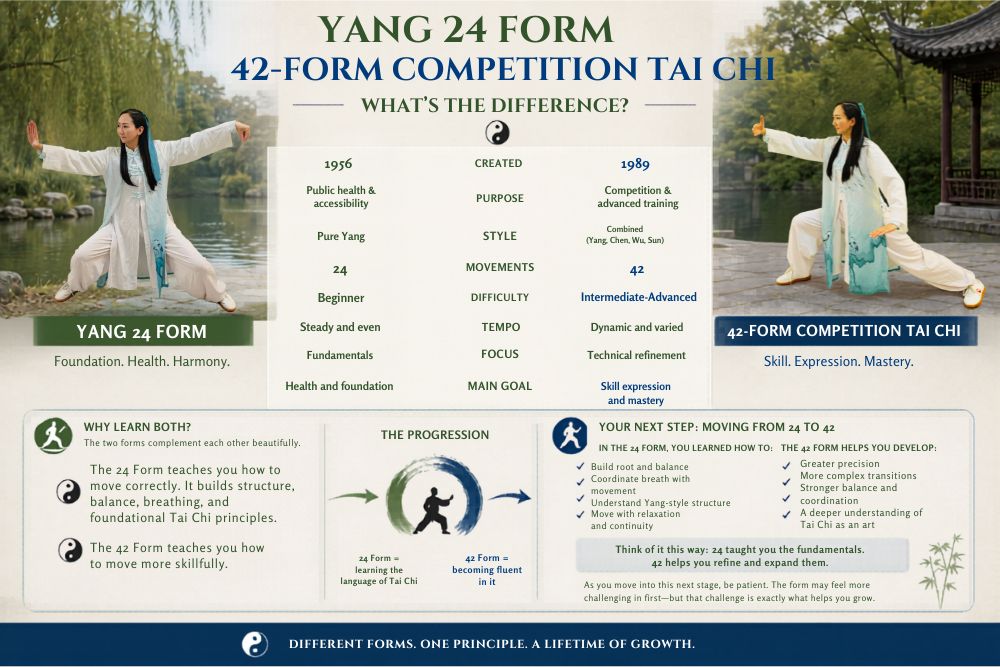
One of the most common questions Tai Chi students ask is:
“What is the difference between the Yang Style 24 Form and the 42-Form Competition Tai Chi?”
While both forms share the same Tai Chi principles of relaxation, balance, coordination, and mindful movement, they were created for different purposes and serve different roles in a practitioner’s development.
Understanding the differences can help you choose the right form for your current level and goals.
Key Differences Between the 24 and 42 Forms
| Feature | Yang 24 Form | 42-Form Competition Tai Chi |
|---|---|---|
| Created | 1956 | 1989 |
| Purpose | Public health and accessibility | Competition and advanced training |
| Style | Pure Yang Style | Combined Yang, Chen, Wu, and Sun Styles |
| Movements | 24 | 42 |
| Difficulty | Beginner-Friendly | Intermediate to Advanced |
| Tempo | Steady and even | Dynamic and varied |
| Focus | Fundamentals and consistency | Technical refinement and expression |
| Main Goal | Health, wellness, and foundation | Skill development and mastery |
The Yang 24 Form: Building a Strong Foundation
The Yang Style 24 Form, also known as the Beijing 24 Form, was created in 1956 to make Tai Chi more accessible to the general public.
Its movements are derived primarily from the traditional Yang Style Long Form and emphasize:
- Balance and coordination
- Relaxation and body awareness
- Breath-body connection
- Rooting and weight shifting
- Smooth, continuous movement
Because of its simplicity and accessibility, the 24 Form is often the first form students learn and serves as the foundation for future Tai Chi study.
The 42 Form: Expanding Your Tai Chi Skills
The 42-Form Competition Tai Chi was developed in 1989 for international Tai Chi and Wushu competition.
Unlike the 24 Form, it combines elements from four major Tai Chi styles:
- Yang Style — smooth and expansive movements
- Chen Style — spiraling energy and lower stances
- Wu Style — compact precision and refined angles
- Sun Style — agile footwork and lively transitions
The result is a more technically demanding routine that challenges practitioners with:
- One-leg balances
- Advanced transitions
- Directional changes
- Kicks and turns
- Greater precision and control
The 42 Form is typically taught after students have developed a solid foundation in Tai Chi fundamentals.
Why Learn Both?
The two forms complement each other beautifully.
The 24 Form teaches you how to move correctly. It builds structure, balance, breathing, and the foundational principles that make Tai Chi effective.
The 42 Form teaches you how to move more skillfully. It expands your movement vocabulary, introduces new challenges, and deepens your understanding of Tai Chi as both a martial art and a lifelong practice.
A simple way to understand the progression is:
24 Form = Learning the language of Tai Chi
42 Form = Becoming fluent in it
Moving from 24 to 42
For students who have completed the Yang 24 Form, beginning the 42 Form marks an exciting transition.
In the 24 Form, you learned how to:
- Build root and balance
- Coordinate breath with movement
- Understand Yang-style structure
- Move with relaxation and continuity
The 42 Form asks you to take those same skills to a higher level by developing:
- Greater precision
- More complex transitions
- Stronger balance and coordination
- A deeper understanding of Tai Chi as an art
Think of it this way:
24 Form teaches the fundamentals.
42 Form refines and expands them.
As you move into this next stage, be patient. The form may feel more challenging at first, but that challenge is exactly what helps you grow as a Tai Chi practitioner.
Which Form Should You Learn First?
For most students, the answer is simple:
Start with the Yang Style 24 Form.
Once the principles of posture, balance, breathing, and coordination become natural, the 42 Form becomes much easier to understand and enjoy.
The strongest practitioners are rarely the ones who rush into advanced forms. They are the ones who build a solid foundation first and then expand upon it through consistent practice.
Leave a Reply